
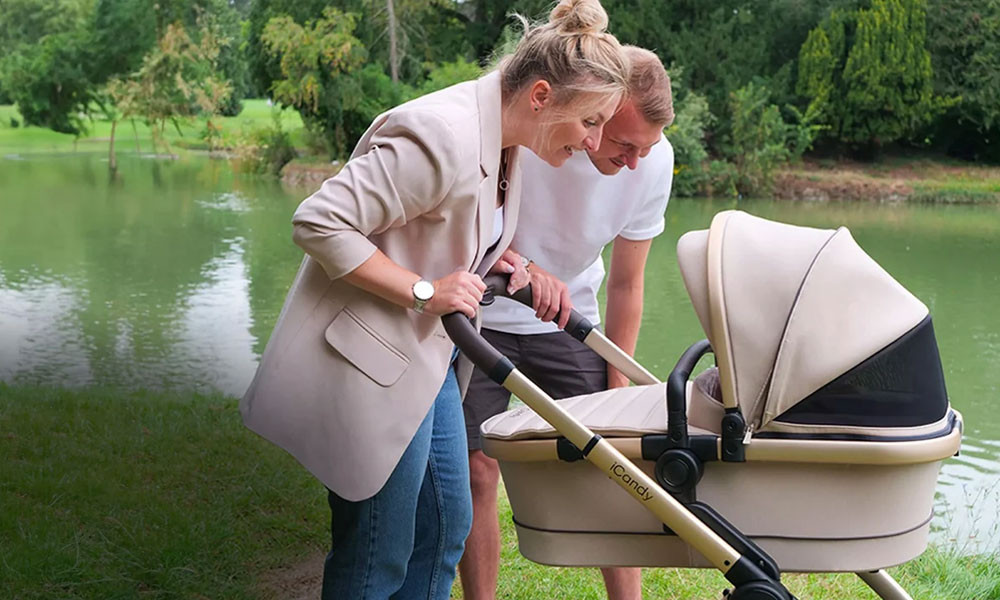
If your baby falls asleep in their pram while you're out for a walk, you might wonder: can babies sleep in a pram, and is it safe to let them carry on sleeping?
The answer depends on the type of pram or pushchair you are using.
Some carrycots are specifically designed and approved for overnight sleeping, while other pushchair seats and carrycots are intended for travelling or daytime use only. This is why it's important to check the manufacturer's instructions for your specific pram before using it as a sleep space.
In this guide, we'll explain when a baby can sleep in a pram, what to look for in a suitable carrycot and the safer-sleep advice every parent should know.
Can babies sleep in a pram?
Some babies can sleep in a pram carrycot, but not every pram or carrycot is designed for sleep.
A suitable cot, carrycot, Moses basket or travel cot that meets the relevant safety requirements and is used according to the manufacturer's instructions provides a separate sleep space for a baby. Current Department for Education guidance for early-years providers also identifies a suitable carrycot as one of the appropriate sleep spaces for babies aged 12 months and under.
The Lullaby Trust advises checking whether the manufacturer states that a particular carrycot is suitable for overnight sleep. This means you shouldn't assume that because a pram or carrycot lies flat, it is automatically suitable for overnight sleeping.
Always check:
- Is the sleep surface completely flat?
- Is the mattress firm and suitable for the carrycot?
- Does the manufacturer state that the carrycot is suitable for sleep?
- Is the carrycot being used exactly as instructed by the manufacturer?
- Are you following current safer-sleep guidance?
Can babies sleep in a pram carrycot?
A carrycot is different from a traditional pushchair seat.
Carrycots are designed to allow a baby to lie flat, and some models are specifically designed for sleeping. However, this doesn't mean that every carrycot is suitable for overnight sleep.
For example, the iCandy Peach 8 carrycot is specifically described by iCandy as suitable for permanent overnight sleeping, including when used at home or away. iCandy also states that the Peach 8 carrycot is offered in partnership with The Lullaby Trust and has increased airflow.
This demonstrates why checking the specific model is so important.
What about a pushchair seat?
A pushchair seat is not automatically suitable for sleep simply because it reclines or goes completely flat.
The Lullaby Trust advises against babies sleeping in a seated or inclined position, including in pushchairs and buggies.
If your baby falls asleep while travelling in their pushchair, check the manufacturer's instructions and, where appropriate, move them to a suitable flat sleep space.
Current Department for Education guidance for early-years providers also states that a lie-flat pram or lie-flat pushchair should not be a baby's main separate sleep space.
The important difference is between a pushchair seat and a purpose-designed carrycot.
What makes a carrycot suitable for sleep?
If you're looking for a pram that can also provide a sleep space while you're away from home, there are several things to consider.
- A completely flat sleep surface
Your baby's sleep surface should be flat rather than tilted or inclined.
The Lullaby Trust recommends that babies sleep on a firm, flat surface and advises against tilting, inclining or propping the mattress or baby.
- A firm, suitable mattress
The mattress should be firm, flat and suitable for the carrycot.
Always use the mattress supplied with the product or one specifically approved by the manufacturer. Don't add extra mattresses, padding, cushions or other soft items unless they are specifically approved for your particular model.
- A clear sleep space
A carrycot used as a sleep space should be kept clear.
Avoid adding:
- Pillows
- Duvets
- Loose blankets
- Soft toys
- Cot bumpers
- Sleep positioners
- Unapproved padding or accessories
The Lullaby Trust recommends keeping a baby's sleep space clear of unnecessary items that could cover their face or affect their breathing.
- Good ventilation
Ventilation is another important consideration, particularly because the enclosed sides of a carrycot can retain heat.
The Lullaby Trust advises that the sides of a pram carrycot can trap more heat than a regular cot, so parents should check their baby's temperature and adjust clothing or bedding if necessary.
Check your baby's chest or the back of their neck. If they feel sweaty or clammy, they may be too hot.
Can a baby sleep in a pram overnight?
Only if the specific carrycot has been designed and approved by its manufacturer for overnight sleeping.
There are pram systems where the manufacturer specifically states that the carrycot is suitable for overnight sleep.
For example:
The Peach 8 carrycot is described by iCandy as suitable for permanent overnight sleeping, including at home or away. iCandy also states that the carrycot is offered in partnership with The Lullaby Trust.
Joolz states that its Day⁵ cot is suitable for overnight sleeping and features a breathable mattress.
Joolz describes its Hub2 cot as overnight sleep compatible, with a breathable mattress.
However, this doesn't mean every carrycot from these brands, or every pram generally, is suitable for overnight sleeping. Always check the exact model and current manufacturer's instructions.
Not all carrycots are suitable for overnight sleep
This is one of the most important things for parents to understand.
A carrycot being flat does not automatically mean that it has been designed or approved for overnight sleeping.
For example, Joie's Ramble XL is specifically described by Joie as approved for overnight sleeping and provides a 180° lie-flat position.
So, never assume that a carrycot is suitable for overnight sleep simply because it is flat.
Always check the manufacturer's instructions for your exact model.
What position should a baby sleep in a pram?
If a carrycot is being used as a suitable sleep space, your baby should be placed on their back.
The Lullaby Trust recommends placing babies on their backs for every sleep, day and night.
The sleep surface should remain flat, with no pillows, wedges or positioners used to prop your baby up.
If your baby has reflux or another medical condition and you've been advised to position them differently, speak to your healthcare professional about the appropriate advice.
Can a baby sleep in a pram indoors?
A suitable carrycot may be used as a sleep space indoors when the manufacturer says it is suitable for sleep, but always follow the manufacturer's instructions and current safer-sleep guidance.
The Lullaby Trust provides specific advice for using a pram or carrycot as an indoor sleep space when a cot or other suitable sleep space isn't available. In this specific situation, it recommends ensuring that the base is flat, keeping the hood down indoors, not covering the pram and removing the carrycot apron.
A pram carrycot should not automatically be treated as a replacement for your baby's usual cot or Moses basket.
What if my baby falls asleep in their pram?
Don't panic!
If your baby falls asleep during a walk, the first thing to consider is what type of pram or pushchair they are sleeping in.
If they're in a suitable, manufacturer-approved carrycot designed for sleep, follow the manufacturer's instructions and current safer-sleep guidance.
If they're sleeping in a pushchair seat or another product that isn't designed as a sleep space, they should be moved to an appropriate flat sleep surface as soon as reasonably possible.
The key consideration is whether the product is actually designed and suitable for sleep — rather than simply whether your baby has fallen asleep in it.
How to keep your baby comfortable while sleeping in a carrycot
It can be tempting to add extra blankets, cushions or accessories to make your baby more comfortable, but more isn't necessarily safer.
Instead:
- Keep the sleep space clear.
- Use only the mattress supplied or approved by the manufacturer.
- Place your baby on their back.
- Keep the sleep surface flat.
- Avoid overheating.
- Don't cover the pram or carrycot with a blanket or muslin.
- Keep the hood down when using a pram indoors, where the specific indoor guidance applies.
- Follow the manufacturer's instructions.
- Check your baby's temperature regularly.
The Lullaby Trust advises against covering a pram or buggy and highlights the potential for carrycot sides to trap heat.
Pram sleep: a quick checklist
Before allowing your baby to sleep in a pram carrycot, ask yourself:
✓ Is the carrycot specifically suitable for sleep?
✓ Does the manufacturer allow overnight sleeping if you intend to use it overnight?
✓ Is the base completely flat?
✓ Is the mattress firm, flat and suitable for the carrycot?
✓ Is your baby lying on their back?
✓ Is the sleep space clear of unnecessary items?
✓ Is your baby dressed appropriately so they don't overheat?
✓ Is the carrycot well ventilated?
✓ Are you following the manufacturer's instructions?
If you can't answer these questions confidently, check the manufacturer's instructions before using the pram as a sleep space.
Pramworld's advice
There isn't one simple answer to “Can babies sleep in a pram?”
Some carrycots are specifically designed and approved for sleep, while others are intended for travelling or daytime use only.
The safest approach is to check the exact pram or carrycot you're using, follow the manufacturer's instructions and follow current safer-sleep advice.
At Pramworld, our team can help you understand the differences between carrycots, pushchair seats and travel systems and help you find a pram that's suitable for your family's needs.
Need help choosing your pram? Get in touch with our team or visit us in-store for advice.
Important safety information
This article provides general information and does not replace the instructions supplied with your specific pram, carrycot or other baby product. Products differ between models, so always check the manufacturer's instructions before using a carrycot or pram as a sleep space.
For current safer-sleep advice, follow guidance from trusted organisations such as The Lullaby Trust, UK Government and NHS.